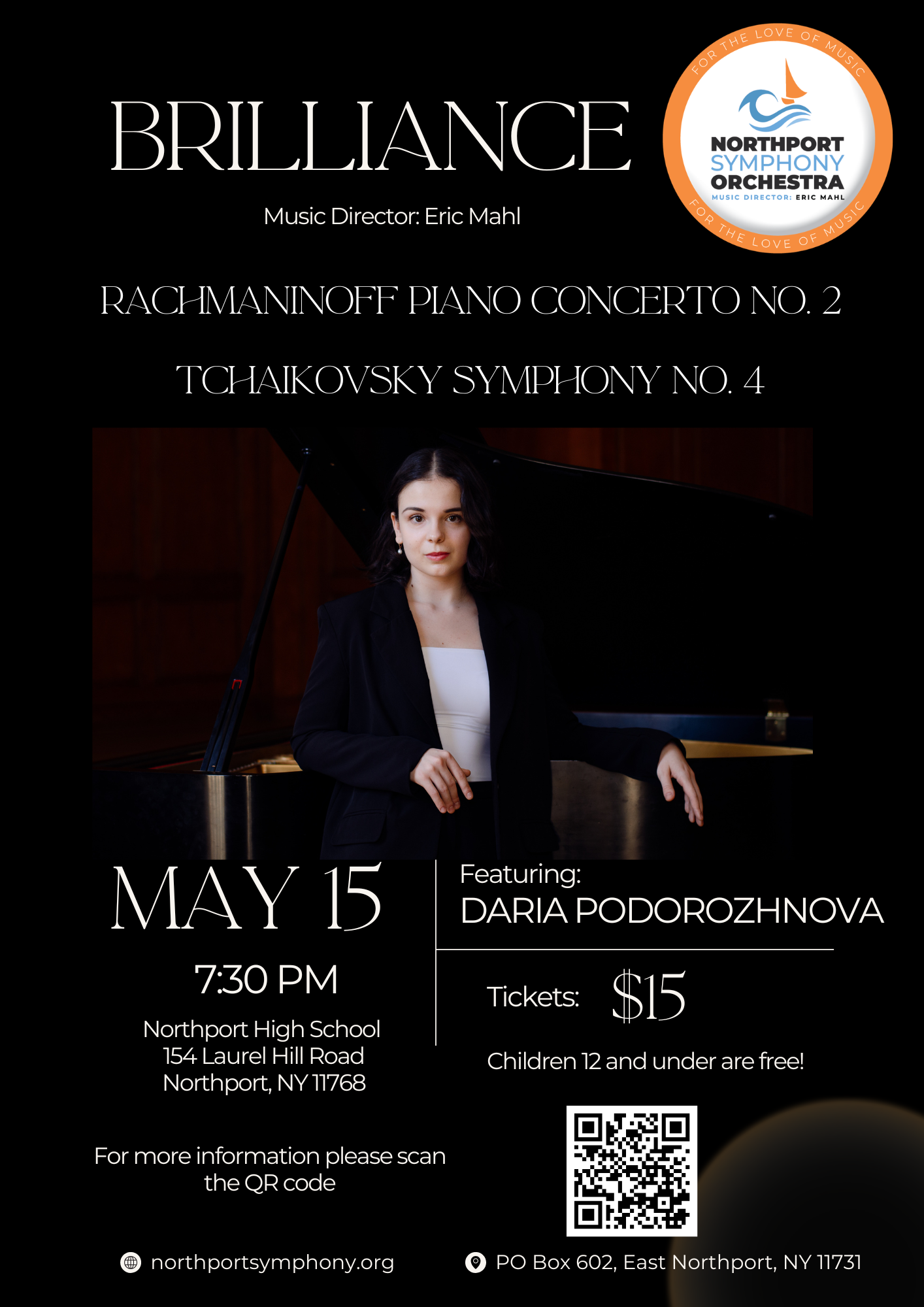
BRILLIANCE
Tchaikovsky and Rachmaninoff
Friday, May 15, 2026
7:30 pm
Northport High School
Tickets 15.00 at the door
PROGRAM NOTES
Symphony No. 4 in F Minor
Pyotr Ilyich Tchaikovsky
About the work
Composed in 1877 and 1878, Tchaikovsky dedicated this symphony to his patroness and close friend, Nadezhda von Mek. He writes:
“You asked me whether there is a definite programme to this symphony? Usually when this question is put to me about a symphonic work my answer is: none! Indeed, this is a difficult question to answer.”
And yet, the composer goes on in the same correspondence to sketch out a detailed conceptual landscape for this lyrical work. The opening movement, marked Moderato, begins with a motif in the brass, a clarion call which he calls “…that fateful force which prevents the impulse to happiness from attaining its goal, which jealously ensures that peace and happiness shall not be complete and unclouded, which hangs above the head like the sword of Damocles, unwaveringly, constantly poisoning the soul. It is an invincible force that can never be overcome — merely endured, hopelessly.” Tchaikovsky doesn’t leave us there, however. As the movement unfolds we experience alternating expressions of spirituality, bursts of hope and, yes, the harsher realities of grim existence. In the end, “…no haven exists... [and we] drift upon that sea until it engulfs and submerges you in its depths.”
In the following movement, marked Andantino in Modo di Canzone, a melancholy oboe solo is supported by the strings. The composer tells us that he envisioned this section as a sentimental reflection on early life. “Life is wearisome. It is pleasant to rest and look around. Memories abound!” The mood is bittersweet.
The third movement, a Scherzo, consists of a “whimsical arabesque” about nothing in particular except the free rein of the imagination. The Finale, marked Allegro con fuoco, is forceful, energetic and lively, depicting the “festive merriment of ordinary people.” But wait — there is fate again, pulling us back to earth. The work ends grandly, optimistically. “To live,” Tchaikovsky writes, “is still possible.”
Symphony No. 4 premiered in Moscow in October 1878 and a month later in St. Petersburg. Following that performance, a critic wrote that “…the end of the Finale was greeted with unanimous applause, calls and stamping of feet ... The performance was very lively, but in the last movement... breathtaking.”
About the composer
Born 1840 in the small Russian town of Votkinsk, Tchaikovsky’s life was complicated by loss and bouts of depression despite his great public success. His relationship with women was fraught. The first trauma was separation from his mother when he attended boarding school at the age of 10. Scholars debate whether she was distant and cold as some have asserted. There was a brief failed marriage to a former student, Antonina Milukova. There was the collapse of a 13-year association with Nadezhda von Meck, who was his friend and muse. And there was his homosexuality, which Tchaikovsky kept hidden from his public. The real cause of his early death at 53, reportedly from cholera, has been disputed by historians, with some suggesting that it was intentional.
Tchaikovsky composed 10 operas, 8 symphonies, 4 concertos (3 for piano, one for violin), choral music, chamber and incidental music in a variety of forms. But it was his ballets — Swan Lake, Sleeping Beauty, and of course The Nutcracker — that endeared him to a wide, general audience. Musically, he inhabited two worlds. One of these he shared with Modest Mussorgsky (“Pictures at an Exhibition”), Rimsky-Korsakov (“Scheherazade") and their countrymen who attempted in the late 19th century to forge a uniquely Russian idiom. However, his training in “western” music at the St. Petersburg Conservatory set him on a different path. Ultimately, his efforts to reconcile these influences yielded a unique artistic voice, bringing Tchaikovsky recognition in his own time, and an enduring place in the pantheon of musical giants.
Concerto for Piano and Orchestra No. 2 in C minor op. 18
Sergei Rachmaninoff
About the music
The history of this concerto, among the best loved in all the piano literature, is a remarkable one. Following a disastrous premiere of his Symphony No. 1 in 1897, Rachmaninov entered a period of deep despair. He was drinking heavily, and it was not clear that he would ever compose again. A family friend connected him with the hypnotherapist Dr. Nikolai Dahl, who worked with him during daily sessions over a period of months, foregoing his usual fee for the struggling composer. “You will begin to write a concerto. You will work with great facility. The concerto will be of excellent quality.”
The result was Rachmaninov’s Piano Concerto No. 2, which premiered in 1901 to critical acclaim. The piece opens dramatically, with a series of rich piano solo chords tolling like bells for eight measures in F major, before the orchestra enters with the surging main “do-re-do” (C-D-C) theme in C minor. The themes and textures are boldly and unambiguously Russian, and the absence of a cadenza allows the movement to flow richly.
In the second movement, in E flat, marked Adagio sostuento, the mood changes. There is a gorgeous duet between piano and clarinet. The finale includes one of Rachmaninov’s best known melodies, presented in the oboes and violas, and it is languid and rich. In contrast to those works in which the orchestra and solo instrument seem to be striving or competing, here there is only harmonious collaboration in the service of lyricism and beauty.
About the composer
Sergei Rachmaninoff (1873 - 1943) once complained to a friend: “When I am concertizing I cannot compose, when I feel like writing music I have to concentrate on that; I cannot touch the piano. When I am conducting I can neither compose nor play concerts… I have to concentrate on any one thing I am doing to such a degree that it does not seem to allow me to take up anything else.” And yet, Rachmaninoff pursued a formidable conducting career while enjoying a reputation as the most accomplished concert pianist of his era. Today, of course, he is most known for neither of these achievements, but as a composer of enduring importance, despite his detractors, and an exponent of a Romanticism infused with the culture and music of his mother Russia.
Rachmaninoff lived through the invention of the light bulb and the automobile, the Bolshevik Revolution, the execution of the Russian royal family, and a World War. We could describe him as a citizen of the world, living at various times in Scandinavia, Germany, Switzerland and the US…but he was first, foremost, and, to the end, a Russian. Born in Onega, Novgorod District in the Russian Empire into a family of declining fortunes, his father’s early plans for a military career were undone by fate: the boy was proficient at the piano by the age of four, and was blessed with perfect pitch, great technical facility, and an exceptional memory. With his grandmother’s help, he found himself by the age of 12 a student at the famed Moscow Conservatory, where his studies progressed and his compositional work began in earnest. During the next decade and a half, he concertized frequently in Europe and came for the first time to America for a tour which began with a recital at Smith College in Massachusetts. On November 28, 1909, he gave the world premiere of his Piano Concerto No. 3 in D minor with the New York Symphony Society.
Disheartened by the transformation of his homeland, Rachmaninoff escaped Russia in 1917, living for a year in Scandinavia before coming to the US, where he undertook a second concert tour. From 1918 to 1935, while continuing to tour frequently in America, he took up residence in a villa on the banks of Lake Lucerne in Switzerland. After 1935, he lived mostly in New York and, later in Beverly Hills. However, at the NSO we like to think of Rachmaninoff as a “local composer” because he lived for a time in an estate located on the Little Neck peninsula, in Centerport, New York.
His major works include 3 symphonies and 4 piano concertos, including this evening’s work, many additional works for solo piano, choral works and vocal pieces, as well as a cello sonata and other chamber works.